Flowers & Décor
Dried vs. Silk vs. Fresh Wedding Flowers: Which Is Right for You?
Fresh flowers are gorgeous and fleeting. Dried are romantic and enduring. Silk have quietly become indistinguishable from real at premium quality. Here is the honest comparison every bride needs before committing her floral budget.
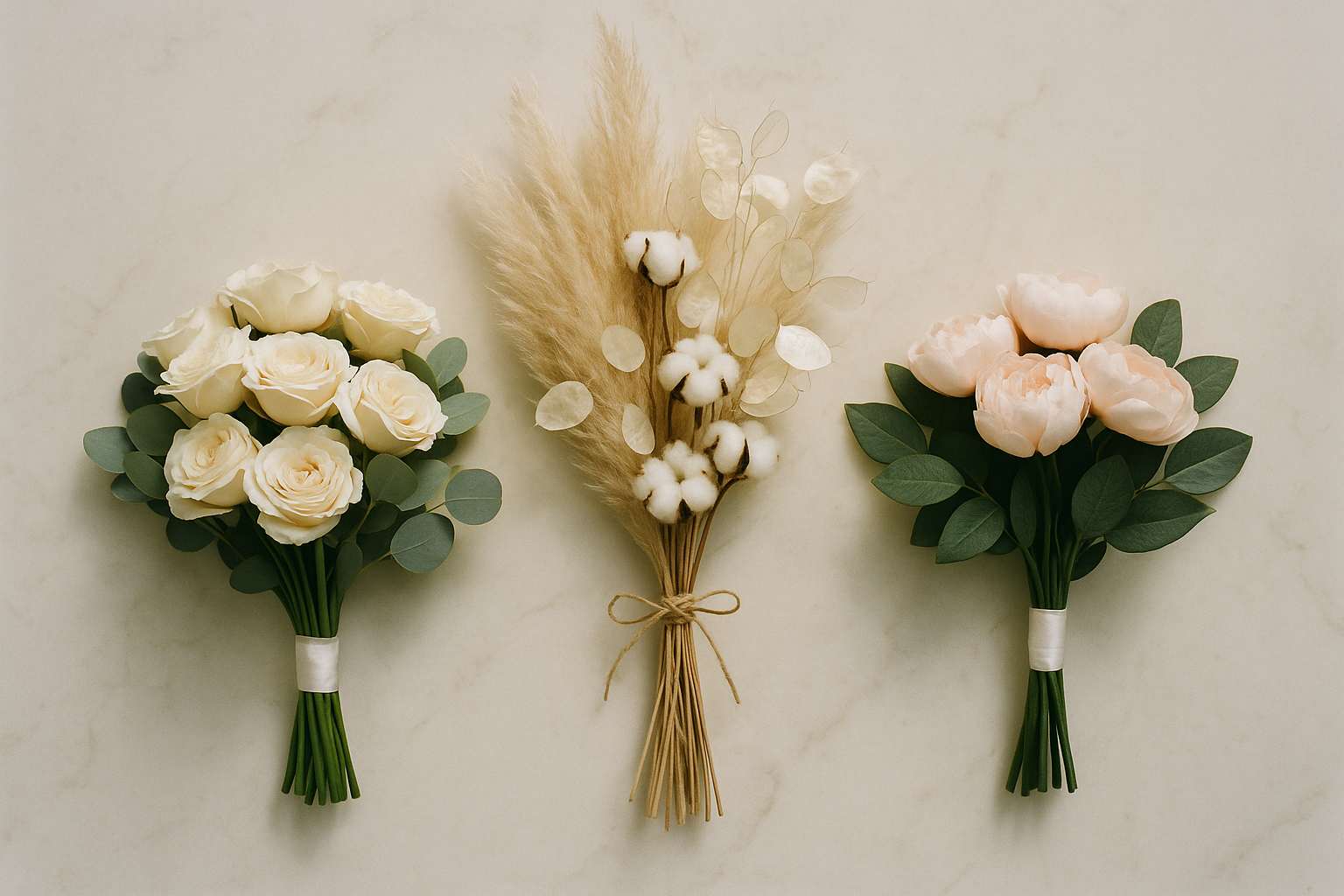
Fresh wedding flowers remain the most emotionally resonant and photography-optimal choice but cost $2,500–$7,000 for a full wedding. Silk saves $1,500–$4,000 at premium quality levels that are now camera-indistinguishable from fresh. Dried flowers offer lasting beauty and a gentler price point, but require careful outdoor handling. Most couples in 2026 are choosing a thoughtful hybrid of all three.
How do fresh, silk, and dried wedding flowers actually compare in cost?
Cost is the first practical consideration, and the numbers vary more dramatically than most couples expect before they begin researching. According to The Knot's 2025 wedding flower cost data, couples spend an average of $2,800 on wedding florals nationally, though Zola's full-service data places the average closer to $6,300 for couples using professional florists for complete ceremony and reception packages. The range reflects enormous variation in wedding size, market, and scope.
A full silk package covering the same items — bridal bouquet, bridesmaid bouquets, ceremony arch, centerpieces, and boutonnieres — typically runs $860–$1,968 at premium quality. That is a potential saving of $1,500 to over $4,000 against fresh pricing, depending on scale. Dried flowers occupy a middle position: specialist-built dried bouquets run $80–$250, and full dried floral packages can be comparable to or somewhat less than fresh, depending on the studio and complexity of design.
| Item | Fresh Cost | Silk Cost | Dried Cost |
|---|---|---|---|
| Bridal bouquet | $250–$350 | $31–$179 | $80–$250 |
| Bridesmaid bouquet (each) | $55–$125 | $25–$80 | $40–$100 |
| Boutonniere (each) | $20–$55 | $8–$30 | $15–$40 |
| Ceremony arch/chuppah | $800–$3,500+ | $300–$1,200 | $400–$1,800 |
| Centerpieces (per table) | $75–$250 | $35–$120 | $50–$180 |
| Full wedding package | $2,500–$7,000+ | $860–$1,968 | $1,200–$4,500 |
What are the real advantages and limitations of fresh wedding flowers?
Fresh flowers remain the gold standard of wedding florals for a reason: nothing else replicates the sensory experience. The fragrance of garden roses, the micro-texture of a freshly opened peony petal, the way light moves through a dahlia — these qualities cannot be manufactured. For a bride who has imagined her bouquet her entire life, fresh flowers often represent a non-negotiable. They also photograph with a depth and naturalism that even the best silk currently struggles to fully replicate across every bloom type.
The limitations are real and worth planning around. Fresh flowers have time-sensitive logistics: arrangements are delivered the morning of the wedding and last 12–24 hours at typical reception conditions. Heat accelerates wilting; outdoor summer ceremonies require specific heat-tolerant varieties or floral refrigeration. Out-of-season flowers cost 30–50% more than in-season equivalents, which makes it expensive to have peonies at an October wedding or dahlias in April. The most practical approach to fresh flowers is to choose a palette and aesthetic first, then trust your florist to select the most beautiful in-season options within that brief — rather than specifying exact varieties that may require expensive imports.
When do silk wedding flowers make the most sense?
Silk flowers have crossed a quality threshold in 2025–2026 that makes them a genuinely competitive choice for couples who know where to invest. The key distinction is between budget-tier silk — available on general retail platforms at $1–$3 per stem, identifiable by its flat petal color, uniform texture, and plasticky weight — and premium real-touch silk at $5–$10 per stem, where the differences from fresh become nearly invisible in photographs and in person.
The situations where silk makes the most sense: destination weddings, where travel stability and heat resistance are paramount; summer outdoor ceremonies in climates above 90°F, where even heat-tolerant fresh flowers struggle; long multi-day celebrations like South Asian weddings where arrangements must hold perfectly across several events; and brides who want to keep their bouquet as a pristine display piece rather than paying for separate preservation services. Premium silk bouquets, purchased once and maintained properly, retail on resale platforms for 40–60% of their original cost, offering a financial flexibility that fresh flowers do not.
What makes dried wedding flowers distinctive — and who are they right for?
Dried and preserved florals offer something neither fresh nor silk can fully replicate: the poetry of impermanence made permanent. A dried bouquet of pampas grass, lunaria, and bunny tail grass feels like it was gathered from a meadow and pressed in time — it carries a warmth and authenticity that resonates deeply with bohemian, rustic, cottagecore, maximalist, and vintage aesthetics.
Beyond aesthetics, dried flowers have practical virtues. They can be assembled weeks before the wedding, eliminating florist scheduling pressure and wedding-week delivery logistics. They become lasting keepsakes without additional preservation cost. Their gentle, muted tones — the characteristic dusty rose, warm camel, ivory, and sage of dried botanicals — photograph with a soft-film quality that many contemporary brides actively seek.
The limitations: dried flowers shed and are fragile under wind and rough handling, making them less ideal for exposed outdoor installations. Their palette tends toward the muted and earthy; achieving deep saturated color in dried form is difficult. And while dried arrangements are typically less expensive than comparable fresh designs, large-scale installations (a full ceremony arch entirely in dried florals) can approach fresh pricing from specialist studios that invest significant labor in sculpting and preserving at volume.
What is the hybrid approach, and why do so many 2026 brides choose it?
The hybrid approach — combining fresh, dried, and silk elements deliberately within a single wedding — is the fastest-growing design direction in contemporary wedding florals. The logic is straightforward: use each material where it performs best, and let the combination do what no single option achieves alone.
A typical 2026 hybrid design: a fresh bridal bouquet of garden roses and eucalyptus (maximum fragrance and photography impact where the camera is closest); silk or dried bridesmaid bouquets (cost-effective, visually cohesive, no wilting risk during the long bridal party morning); a ceremony arch combining fresh hero blooms with dried pampas and silk leaf greenery (visual richness at lower cost than all-fresh); and centerpieces built from dried grasses and cotton stems accented with a handful of fresh stems for each table (beautiful, long-lasting through the reception, and distinctly original). This approach reduces fresh flower spend by 30–50% without compromising the visual result, and it allows the bridal bouquet — the most photographed, most emotionally significant piece — to remain entirely in fresh without budget guilt.
Frequently asked
What is the real cost difference between fresh, silk, and dried wedding flowers?
The cost gap is significant. A fresh bridal bouquet from a professional florist typically runs $250–$350; a comparable silk bouquet runs $31–$179; a dried bouquet from a specialist runs $80–$250. For a full wedding — bouquet, bridesmaids' bouquets, ceremony arch, centerpieces, boutonnieres — fresh floral packages average $2,500–$7,000 nationally (Knot 2025 data). An equivalent silk package from a premium specialist runs approximately $860–$1,968, a potential saving of $1,500 to $4,000+. Dried flowers sit between the two in most scenarios, though large-scale dried installations can approach fresh pricing when custom-built by a specialist studio. The hybrid approach — fresh for the bridal bouquet and ceremony focal pieces, silk or dried for bridesmaids and venue fills — often delivers the best visual result at a mid-range price point.
Can wedding photographers tell the difference between silk and fresh flowers in photos?
At premium quality levels, skilled wedding photographers frequently cannot distinguish silk from fresh in photographs — and this has been the case since roughly 2022, when high-end silk manufacturing reached a new level of petal texture, vein detail, and color gradation. Budget-tier silk, by contrast, is identifiable in photography because the petals lack depth, the color is uniform, and the weight does not behave naturally in the bouquet. The investment threshold for photography-safe silk is approximately $5–$10 per stem for real-touch varieties, versus $1–$3 for standard silk. If wedding photography is important to you and you are considering silk, request a physical sample before committing; photograph it in natural light with your phone, and compare it to reference images. The test almost never lies.
Are dried flowers right for an outdoor wedding?
Dried flowers are beautiful for outdoor weddings in controlled conditions, but they require thoughtful logistics for exposed outdoor settings. The primary risk is wind: dried florals — particularly pampas grass, bunny tail grass, and lunaria — are fragile and can shed when buffeted by gusts. Rain is a secondary concern; while dried flowers can tolerate light humidity, prolonged moisture will cause preserved blooms to soften and lose their shape. For outdoor ceremonies, keep dried arrangements protected until they are positioned for the ceremony, and place them where they will have some shelter from direct wind. Bouquets and boutonnieres hold up well in mild outdoor conditions. Large floral installations in exposed outdoor spaces are better executed in fresh or silk for reliability.
What is the environmental footprint of each flower type?
This question deserves a nuanced answer. Fresh flowers from local, seasonal, foam-free florists have the smallest carbon footprint per use — particularly when donated or composted after the wedding. Fresh imported flowers (the majority of U.S. supply, primarily from Colombia and Ecuador) carry a meaningful transport and cold-chain footprint. Silk flowers used only once actually carry approximately 2.5 times the greenhouse gas impact of fresh flowers used once, because their production is energy-intensive. However, silk flowers reused two to three times break even with fresh, and resold or repurposed silk arrangements continue to generate environmental value for years. Dried flowers occupy a middle ground: minimal production energy, no cold-chain, but limited reuse potential. The most sustainable wedding florals overall are fresh, local, in-season flowers managed by a foam-free florist with a post-wedding donation program.
Can you mix dried and fresh flowers in the same wedding?
Absolutely — and this hybrid approach is one of the most popular design directions in 2025–2026. Dried elements like pampas grass, lunaria, dried citrus slices, cotton stems, and bunny tail grass blend beautifully and naturally with fresh blooms, adding texture, volume, and a tactile richness that pure-fresh or pure-dried designs rarely achieve alone. A common and effective combination: a fresh garden rose and eucalyptus bridal bouquet paired with dried-element bridesmaid bouquets, dried grass and cotton stem centerpiece accents, and a full dried installation for the ceremony backdrop. This hybrid approach reduces the number of expensive fresh stems needed, eliminates the time pressure of fresh-only logistics, and creates arrangements that continue to look beautiful into the reception evening as fresh flowers begin to fatigue.
Do silk wedding flowers work for traditional or religious ceremonies?
Yes, silk flowers are appropriate for every style of ceremony and reception, including traditional and faith-based celebrations. No major religious tradition prescribes that wedding flowers must be fresh; the symbolic and aesthetic value of flowers — whether as altar decorations, bridal bouquet, or chuppah adornment — is entirely preserved in premium silk. For couples whose faith tradition places specific flowers in a ceremonial role — marigolds in Hindu weddings, white roses in Catholic ceremonies, seasonal blooms at a Jewish chuppah — those varieties are all available in premium silk at high quality. The practical case for silk is actually stronger in certain faith contexts: weddings that span multiple days (Hindu, Sikh) benefit from arrangements that hold perfectly through every ceremony rather than wilting between events. Present your florist with reference photos of silk arrangements to confirm quality before committing.