Reception & Parties
Assigned vs. Open Seating at Your Wedding: Which Is Right for You?
The choice between assigned and open seating shapes the entire rhythm of your reception — from how smoothly guests find their seats to whether Grandma ends up near the dance floor. Here is how to decide with confidence.
For weddings of 50 or more guests, assigned table seating is the industry standard — it protects elderly guests, prevents social cliques from forming, and gives you control over difficult family dynamics. Open seating works beautifully for intimate gatherings under 40. Most couples land happiest with a hybrid: tables assigned, seats within each table left open.
Of all the reception planning decisions you will make, seating is the one that touches every guest personally. Where someone sits shapes who they talk to, whether they feel honored or overlooked, and whether the evening unfolds with graceful flow or low-grade confusion. Approached thoughtfully, a seating chart is one of the most loving things you do for the people in that room.
According to Zola's 2026 First Look Report — based on a survey of more than 11,500 couples — the average U.S. wedding now hosts approximately 145 guests, which typically translates to 12 to 15 round tables of 8 to 10 guests each. That is not a small seating puzzle. Starting early and working systematically is the only approach that holds.
What are the real differences between assigned and open seating?
The choice sounds simple — either you assign seats or you do not — but the implications ripple through every aspect of your reception: meal service logistics, guest experience, photography, and your own peace of mind on the wedding day.
Assigned seating means you have made deliberate decisions about where each guest or group sits. The most popular format is assigning guests to a specific table (but leaving the individual chairs within that table open), which gives you control over group dynamics while allowing guests a small degree of natural freedom once seated. Fully assigned seats — with place cards at each chair — are appropriate for formal plated dinners and weddings with complex family dynamics where precise control matters.
Open seating means guests sit wherever they choose upon arrival. It is genuinely workable in specific circumstances: intimate weddings of 40 guests or fewer, cocktail-style receptions with primarily standing tables, and casual outdoor or backyard gatherings where the informal format is itself part of the aesthetic. Above 50 guests, open seating consistently creates problems: guests cluster near the entrance, groups reserve chairs with jackets and purses leaving awkward gaps, and elderly guests or those who arrived alone face real difficulty finding comfortable placement.
| Factor | Assigned Seating | Open Seating |
|---|---|---|
| Guest count | Recommended for 50+ guests | Works well under 40 guests |
| Meal service | Required for plated dinners; enables meal-choice tracking | Fine for buffet or family-style only |
| Family dynamics | Allows proactive management of divorced parents, estranged relatives | Leaves difficult dynamics to chance |
| Elderly or mobility-limited guests | Ensures accessible, comfortable placement near aisles and restrooms | Leaves them to navigate independently |
| Planning effort | Significant — 3 to 6 hours for most weddings | Minimal |
| Day-of flexibility | Requires a swing table for unexpected additions | Naturally accommodates surprises |
| Venue type | Ballrooms, barns, formal venues of all kinds | Backyard, cocktail-format, micro-wedding settings |
What is the hybrid approach, and is it right for most couples?
The hybrid format — assigning guests to tables while leaving individual seats within each table open — is the sweet spot that most experienced wedding planners now recommend as the default for weddings of 50 to 150 guests. It preserves everything that matters most about assigned seating (group dynamics managed, elderly guests protected, plated service simplified) while giving guests a degree of social freedom and reducing the couple's planning burden.
Some couples extend the hybrid logic further: they assign the tables most critical to the evening's harmony — immediate family, elderly guests, the wedding party — and leave the remaining tables genuinely open. This is a reasonable compromise for casual mid-size weddings, particularly those with buffet or family-style service, as long as you accept that the unassigned section may fill unevenly.
For the vast majority of weddings, the recommendation is consistent: assign every table. The effort required — typically three to six hours of focused work over several planning sessions — is modest relative to the peace of mind it delivers on the day itself.
How do escort cards, place cards, and seating chart displays differ?
Understanding the distinction between these three tools prevents a common and expensive planning error: ordering the wrong format for your service style.
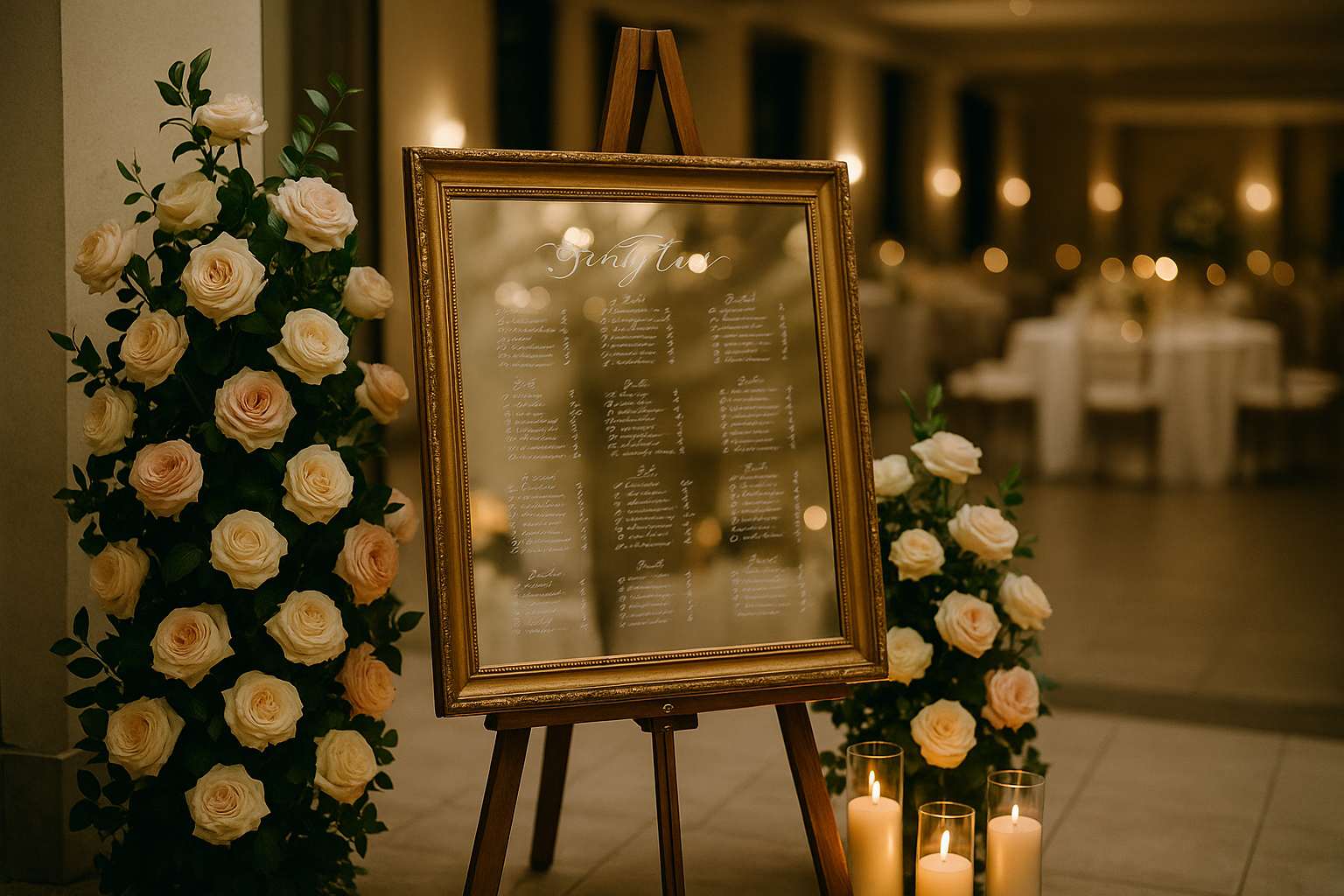
A seating chart display — lettered on a mirror, acrylic board, or framed print and posted near the reception entrance — is the fastest guest-flow format. All guests read the display simultaneously, which eliminates queueing. It is the best choice for weddings of 80 or more guests, buffet or family-style service, and couples who want a statement design moment at the entrance. The fastest-growing format for 2025 to 2026 is the digital seating chart: guests scan a QR code to view their table assignment on their phone, and last-minute changes are made to the underlying document without reprinting. Cost for professionally lettered displays ranges from $150 to $600 or more depending on material and size.
Escort cards — small individual cards issued one per household, not one per person — are picked up at an entrance table. Each card lists the guest's name and their table number. For a wedding of 145 guests, you may need only 80 to 100 escort cards, since couples and families share a single card. This can meaningfully reduce cost if you are using calligraphy. Escort cards work beautifully for intimate-to-midsize weddings and when the card itself doubles as a small favor: seed packets, honey jars, and custom keychains are all popular 2025 to 2026 combinations. The one practical downside: small cards are easily misplaced during cocktail hour.
Place cards are placed at each individual chair before guests enter. They indicate exactly which seat belongs to which guest — essential for plated dinners where meal choices must be tracked and for formal receptions where specific-seat control matters. Place cards must include a meal-choice indicator that servers can read from arm's length in low light: a subtle symbol, color-coded ribbon, or small icon is standard practice. Cost runs from $0.50 to $1.50 each for printed cards to $2 to $6 or more for calligraphed versions on premium materials.
What are the most important seating etiquette rules to follow?
Wedding seating etiquette exists not to restrict your creativity but to protect specific guests who are most vulnerable to being inadvertently overlooked.
Always seat couples together. Separating partners — even to achieve a better numerical balance across tables — is considered one of the most jarring seating errors a host can make. Never create a singles table by grouping all your unattached guests together; it signals social quarantine and is widely considered poor form. Distribute single guests among tables where they share something meaningful with others present: professional interests, stage of life, shared travel experience, or mutual friends.
Honor elderly guests and those with mobility challenges with placement near accessible aisles, comfortable chairs, and easy access to restrooms. Seat children thoughtfully: children over approximately age eight can often sit with their parents depending on table size, while younger children benefit from a dedicated children's table near the wall and close to their parents' tables, with a friendly adult nearby to help manage.
For divorced parents who are amicable, seating them at the same table surrounded by mutual family friends is entirely appropriate. For politely distant co-parents, give each their own table on opposite sides of the room with the dance floor or a central installation as a natural buffer between them. For truly hostile dynamics, treat each parent as the gracious host of their own family table and brief your coordinator specifically. The sweetheart table format — where only the two of you are seated at a small private table — elegantly removes the fraught head-table hierarchy: neither parent is elevated above the other, and both receive their own equally positioned family table.
In Chinese and East Asian traditions, proximity to the couple signals honor — seat elder family members and honored guests closest to you. Avoid table number four in Chinese tradition, where the number sounds like the word for death; table names rather than numbers sidestep this entirely. In Catholic and most Protestant ceremony seating, the bride's family and guests traditionally sit on the left as you face the altar and the groom's on the right, though it is now widely accepted to fill unevenly-sized sections by directing guests to any open seat. Jewish Orthodox ceremonies may separate seating by gender for the ceremony itself; reserved rows for immediate family are standard across most traditions.
Frequently asked
Should I do assigned or open seating at my wedding?
For any reception of 50 or more guests, assigned seating — at minimum assigning guests to a specific table — is strongly recommended by wedding planners. Open seating above that guest count reliably creates confusion: guests cluster near the entrance, elderly guests are left searching for comfortable chairs, and entire sections fill unevenly. The most common and practical approach is to assign guests to tables (not specific seats), giving you control over group dynamics while granting guests a small degree of freedom once seated. Reserve fully open seating for intimate weddings of 40 guests or fewer, casual cocktail-style receptions, or backyard gatherings where the relaxed format is intentional.
What is the difference between escort cards, place cards, and a seating chart display?
These three tools serve distinct functions. A seating chart display — posted near the reception entrance on a mirror, acrylic board, or framed print — shows all guests their table assignments at once; guests read it on arrival and proceed to their table. Escort cards are small individual cards (one per household, not per person) that a guest picks up at the entrance table; each lists the guest's name and table number. Place cards are placed at each individual seat and indicate exactly which chair belongs to which guest — essential for plated dinners where meal choices must be tracked. Many couples use a seating chart display alongside place cards, or escort cards alone for mid-size receptions. Choose based on your service format: buffet weddings rarely need place cards; plated dinners nearly always do.
When should I start working on the wedding seating chart?
Begin your framework — table count, rough groupings by relationship category — as soon as you receive your venue floor plan, typically three to four months before the wedding. Build your first working draft when 70 to 80 percent of RSVPs are in, ideally four to six weeks before the event. Set your RSVP deadline at least four to five weeks before the wedding — not the standard two weeks many couples default to — so you have adequate time to finalize placements. Lock the chart one to two weeks out, limiting changes to true additions or cancellations only. Build in one "swing table" with two to four open seats for unexpected plus-ones or last-minute additions, and always have a printed backup copy for your venue coordinator.
How do I handle seating for divorced parents who do not get along?
Give each parent their own table positioned on opposite sides of the room, using the dance floor, a floral installation, or the bar as a natural buffer between them. Seat each parent as a gracious host of their own family table — surrounded by their respective family members or close friends — so each has a clear social context and appropriate dignity. Brief your wedding coordinator about the dynamic so they can intervene quietly if needed. If you are using a sweetheart table for the two of you rather than a traditional head table, this eliminates the fraught question of which parent sits in the position of honor. Avoid asking feuding family members to simply "be mature" and seat them together; proactive placement protects the evening before tension has the chance to develop.
Is it rude not to have a seating chart at my wedding?
For an intimate wedding of 40 guests or fewer, open seating is entirely gracious — guests know most people present and the scale is manageable. For larger receptions, especially those with plated dinners, elderly guests, or any degree of complex family dynamics, the absence of a seating chart creates genuine discomfort for many guests. Guests arriving at a large reception without direction tend to cluster awkwardly at the entrance, and people with mobility challenges or social anxiety face real difficulty finding comfortable seats on their own. The seating chart is, at its core, an act of hospitality. It communicates to each guest: we thought about you specifically, and we have prepared a place for you.
What are the best tools for building a wedding seating chart?
AllSeated (now Prismm) offers the most sophisticated floor-planning tools, including 3D venue previews, and is used by professional event coordinators; the free tier is accessible to couples. The Knot's built-in seating tool is convenient if your guest list already lives on The Knot platform, since it syncs automatically with your RSVP data. Zola offers a clean iOS-only seating tool suited to smaller weddings. Canva's free and paid tiers work beautifully for designing a printed or digital seating chart display. For couples who prefer full flexibility, a Google Sheets or Airtable setup with columns for guest name, group, dietary restriction, and table assignment remains a reliable DIY approach. Whichever tool you choose, commit to one platform and build everything there; switching mid-process risks data loss and adds to an already complex task.