Invitations, Registry & Gifts
When to Send Wedding Invitations: The Complete 2026 Timeline
Send invitations too early and guests lose them. Send them too late and travel plans fall apart. This guide maps the exact mailing windows, RSVP deadlines, and final counts for every wedding type — including destination and international weddings.
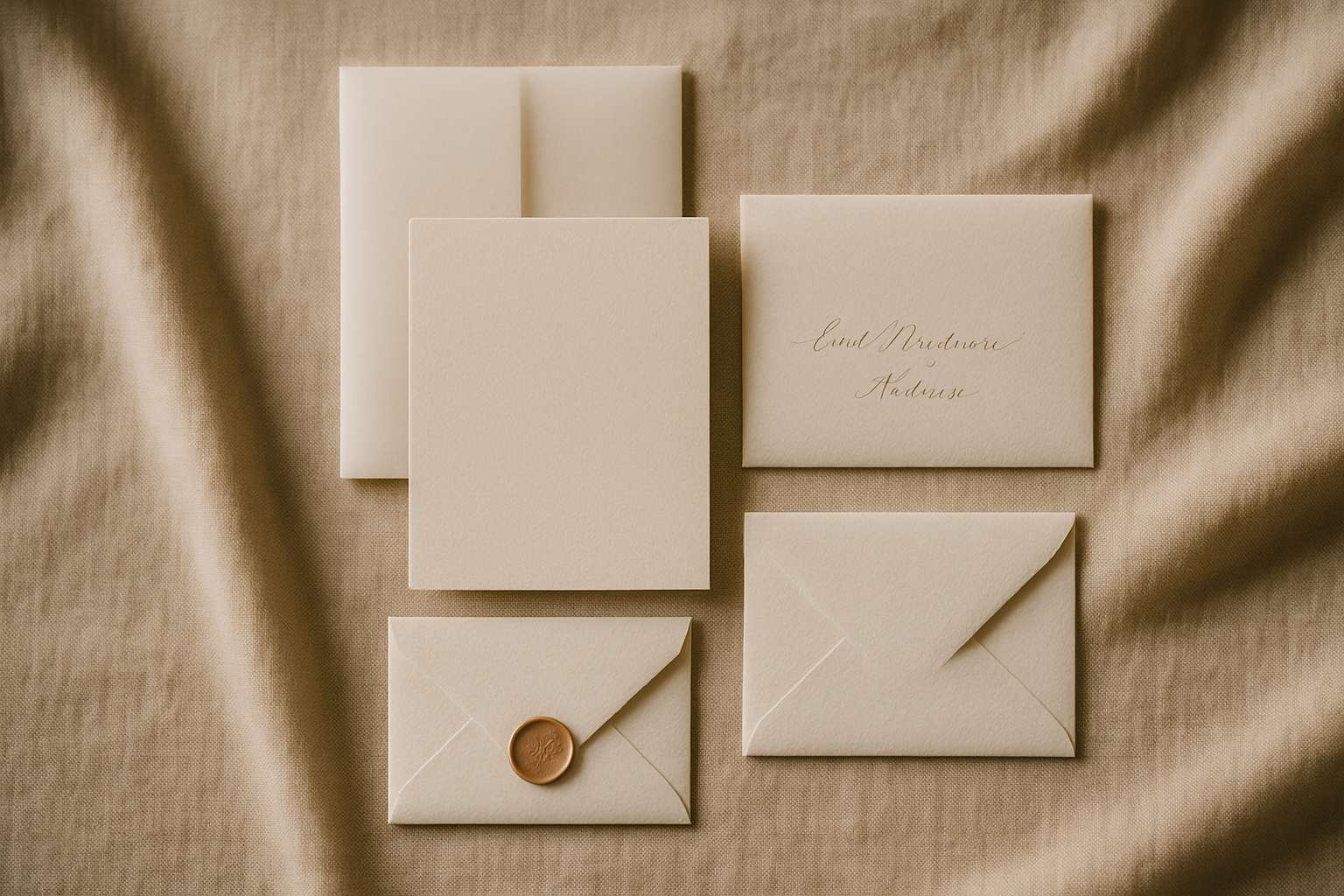
The 6-to-8-week rule for local weddings and 10-to-16-week rule for destination weddings are the practical anchors of invitation timing. Everything downstream — your caterer's final count, your seating chart, your weekend-of timeline — depends on a clean RSVP process. Build the stationery timeline backward from your caterer's final count deadline and you will have every mailing date locked in without guesswork.
When should you send wedding invitations for a local, destination, or international wedding?
The wedding invitation timeline is not arbitrary. It is a logistics chain with hard dependencies at each link: save-the-date → formal invitation → RSVP deadline → caterer final count → seating chart → wedding day timeline. Getting any link wrong creates a ripple effect through every subsequent step.
For local or regional weddings (guests driving or making a short trip), the formal invitation window is 6 to 8 weeks before the wedding date. This is the sweet spot where guests have enough time to arrange schedules, childcare, and travel but not so much time that the invitation gets buried in a pile. Invitations arriving earlier than 3 months before a local wedding commonly get misplaced.
For destination weddings — those requiring flights or overnight hotel stays — mail formal invitations 10 to 16 weeks in advance. The 12-week (3-month) mark is where most planners land. Your invitation suite should include an accommodations insert with your hotel room-block details and booking deadline. Hotels typically release unsold room-block inventory 30 to 60 days before arrival, so your RSVP deadline must fall before your room-block expiration date.
For international or multi-country weddings, 16 to 20 weeks is appropriate for formal invitations. Guests booking international flights need to account for passport and visa timelines, and in some countries, international travel requires employer documentation.
| Wedding type | Save-the-date | Formal invitation | RSVP deadline | Caterer final count |
|---|---|---|---|---|
| Local / regional | 4–8 months before | 6–8 weeks before | 2–4 weeks before | 1–2 weeks before |
| Destination (domestic) | 8–12 months before | 10–16 weeks before | 6–8 weeks before | 2–3 weeks before |
| International | 10–14 months before | 16–20 weeks before | 8–10 weeks before | 2–3 weeks before |
| Micro-wedding (under 30 guests) | 4–6 months before (optional) | 6–8 weeks before | 2–3 weeks before | 7–10 days before |
How do you build the full stationery order and mailing timeline backward from your wedding date?
The most common mistake couples make is ordering stationery without accounting for the production and assembly process. Premium letterpress stationery requires 4 to 8 weeks of production time after proof approval. Digital printing is faster — typically 1 to 2 weeks — but the most distinctive suites are designed, proofed, and revised, adding time. According to The Knot's stationery timeline guidance, couples should work backward from their mailing date to determine when to place the order.
A practical backward timeline for a local Saturday wedding in September:
- Wedding date: September 13
- Caterer final count required: September 2 (11 days before)
- RSVP deadline: August 23 (3 weeks before wedding; 10 days before final count, with buffer for follow-up calls)
- Invitation mailing date: July 5 (10 weeks before, targeting 8-week window)
- Invitation assembly: June 28–July 4 (stuffing, addressing, stamping)
- Invitations arrive from printer: June 21
- Final proof approval: May 31
- First proof review: May 17
- Stationery order placed: May 10 (with a letterpress printer allowing 6 weeks production)
- Save-the-dates mailed: January 13 (8 months before; earlier if holiday weekend or high-demand venue)
What are the etiquette rules for addressing, assembling, and mailing wedding invitations?
The Emily Post Institute maintains the reference standard for invitation etiquette. Key rules for 2026 practice:
Addressing: Inner envelopes use social names as you would address someone in conversation ("Mr. and Mrs. Rivera," "Maya and Jordan," "The Nakamura Family"). Outer mailing envelopes use formal mailing names and addresses. Calligraphy — hand-lettered or printed — remains the standard for formal invitations. Printed calligraphy-style fonts from your stationer are an acceptable alternative when budgets are limited. Do not use address labels on outer envelopes for formal invitations.
Who to address: Each inner envelope should name exactly who is invited. If children are not invited, do not include their names. Do not address the outer envelope to "and family" if you have not extended a children's invitation. If a guest may bring a date whose name you do not know, use "and Guest."
Postage: Take a fully assembled, sealed sample suite to the post office before purchasing postage for the full run. Standard invitation suites commonly require additional postage due to multiple inserts. Square or oversized envelopes are subject to a non-machinable surcharge and require hand-canceling. Ask explicitly for hand-canceling at the post office counter — metered machines can damage wax seals and thick envelopes. RSVP envelopes should be pre-stamped as a guest courtesy.
Extras to order: Print 10 to 15% more invitations than your guest count to account for addressing mistakes, last-minute additions, and keepsakes. Stationers often charge a flat setup fee for reprints — ordering extras upfront is almost always more cost-effective than a second print run.
The etiquette of following up with non-respondents
Plan for 10 to 20% of guests to miss the RSVP deadline without responding. This is industry-standard and not a reflection of their enthusiasm for attending. Build 3 to 5 business days after the RSVP deadline into your timeline specifically for follow-up calls and texts. Assign this task to a trusted person — a bridesmaid, a family member — who can make calls systematically. An online RSVP option on your wedding website (in addition to or instead of a printed RSVP card) dramatically improves response rates, particularly for younger and remote guests.
Frequently asked
When should you send wedding invitations?
The standard window is 6 to 8 weeks before the wedding date for a local or regional wedding. This gives guests enough time to arrange travel, childcare, and time off work without receiving the invitation so far in advance that it gets misplaced. For destination weddings — those requiring flights or multi-night hotel stays — send formal invitations 10 to 16 weeks in advance. International weddings with guests traveling across time zones may warrant 16 to 20 weeks. These windows assume save-the-dates were mailed earlier: 6 to 12 months out for destination weddings, and 4 to 8 months out for local celebrations. Never mail invitations without first assembling and weighing a complete invitation suite at the post office, as the multi-card insert often exceeds single-stamp postage and requires hand-canceling.
When should you send save-the-dates for a wedding?
Save-the-dates serve one purpose: to hold the date in guests' minds before the formal invitation arrives. For local weddings, mail them 4 to 8 months in advance. For destination weddings requiring flights or hotel bookings, 8 to 12 months is the recommended range — and 12 months is appropriate if your wedding falls on a major holiday weekend or in a high-demand travel destination. Save-the-dates are non-optional for destination weddings; without them, guests may book conflicting travel before receiving the invitation. Only send save-the-dates to people you are certain will receive a formal invitation — they are a commitment to invite.
What should your wedding RSVP deadline be?
Set your RSVP deadline 2 to 4 weeks before the wedding date. The ideal deadline lands exactly when your caterer needs final guest count confirmation — typically 7 to 14 days before the wedding. Work backward from your caterer's required final count date and set the RSVP deadline 3 to 5 days before it, giving yourself a window to follow up with non-respondents. If you receive RSVPs primarily by mail, add 5 to 7 business days for postal transit. A common mistake is setting the RSVP deadline too late — the week before your wedding — leaving no time for follow-up phone calls to the 10–20% of guests who typically do not respond without prompting.
How far in advance should destination wedding invitations be sent?
Send destination wedding invitations 10 to 16 weeks before the wedding date; 12 weeks (3 months) is the most common guidance. This window gives guests enough time to book flights, arrange accommodations, and request time off work. Save-the-dates should precede this by 8 to 12 months. Your invitation suite should include an accommodations card listing your room-block hotel and reservation deadline — most hotels release unsold room blocks 30 to 60 days before arrival. Many destination wedding couples also include a separate wedding website card directing guests to a dedicated site with travel logistics, local activities, and an online RSVP option. According to The Knot's guidance, destination wedding guest counts typically run smaller — 40 to 75 guests — given travel requirements.
Is it rude to send invitations too early?
Sending formal invitations more than 3 months before a local or regional wedding can work against you: invitations arrive before guests have their calendars organized, get placed in a drawer, and are subsequently forgotten or misplaced. The 6-to-8-week window is grounded in practical guest behavior, not arbitrary tradition. The exception is destination weddings, where guests need maximum lead time to book travel. For those, the earlier the better — and the save-the-date does the early work of securing the date, letting the formal invitation arrive closer in. If you're concerned guests need more lead time for a local wedding, add a note on your wedding website to your save-the-date rather than mailing the formal invitation earlier than the standard window.
How do you word a wedding invitation?
Traditional wording follows a specific structure: host line (who is issuing the invitation — traditionally the bride's parents, now commonly the couple themselves or both families), request line ('request the honour of your presence' for ceremonies in a house of worship; 'request the pleasure of your company' for secular venues), names of the couple, date and time written out in full (never numerals in formal wording), venue name and city, and reception details on a separate insert card. The Emily Post Institute notes that 'honour' with the British spelling signals a formal church ceremony. Modern couples commonly replace the host line with their own names and eliminate much of the formal language while retaining clear, legible structure. Always include a wedding website URL on a separate details insert to keep the main invitation card uncluttered.
What is the correct order to mail a wedding invitation suite?
Assemble the suite with the invitation on top, then reception/details insert, then accommodations card, then RSVP card (tucked inside its pre-addressed, pre-stamped envelope), placed on top of the stack. Everything is inserted into the inner envelope with printed side toward the back flap, then the inner envelope is placed (unsealed) into the outer mailing envelope with the guest's name facing the outer envelope's back flap. Tissue paper — once a functional element to protect freshly-printed ink from smearing — is optional but still included by traditional stationers. Take one fully assembled, sealed suite to the post office for weighing before affixing postage to your full run. Multi-card suites commonly require additional postage, and square or oversized envelopes require hand-canceling surcharges.